

The backpacking Southeast Asia budget most guides quote is wrong — not maliciously, just outdated. And the gap between their numbers and yours at the ATM is where trips fall apart.
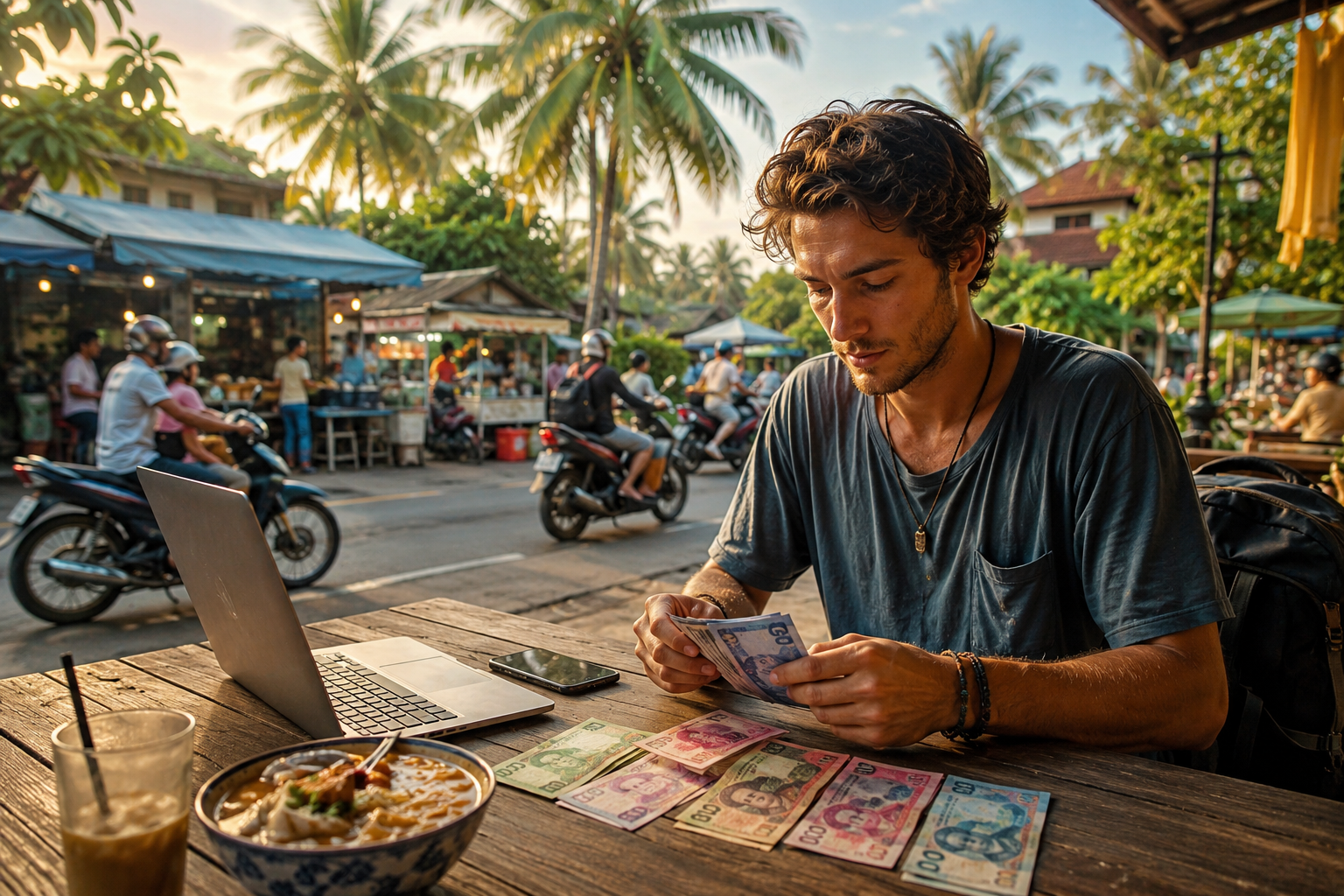
Here’s what happened to the classic “$35/day Southeast Asia” number.
It’s not wrong, exactly. You can still do a backpacking Southeast Asia budget on $35/day. But what that buys in 2026 is meaningfully different from what it bought in 2019. Post-pandemic tourism recovery pushed prices up 10–20% across most of the region. Thailand specifically climbed around 12% year-over-year in 2025 according to Brokepackr’s 2026 Backpacker Cost Index. Bali’s popular areas are no longer budget in any meaningful sense. Even Cambodia and Vietnam — the perennial backpacking budget champions — are seeing price increases in tourist zones.
None of this means Southeast Asia has stopped being exceptional value. It’s still by far the cheapest region in the world for long-term travel. But the Southeast Asia backpacking budget requires more honesty in 2026 than the guides written in 2021 have been giving it.
I’ve pulled real spending data from backpackers and remote workers who went through the region in the last 12 months. This is the updated picture — daily costs by country, three budget tiers, transition costs between countries, the remote worker vs. pure backpacker distinction that most guides ignore, and a seasonal calendar for avoiding expensive peak periods.
No theoretical minimums. Just what people actually spent.
The Three Backpacking Southeast Asia Budget Tiers in 2026
Before the country breakdowns — a frame for who this guide covers, because the numbers differ significantly depending on why you’re traveling.
| Tier | Daily Budget | Monthly | What This Gets You |
|---|---|---|---|
| Shoestring | $20–$30 | $600–$900 | Dorms, street food only, buses everywhere, minimal activities |
| Mid-Range Backpacker | $35–$55 | $1,050–$1,650 | Budget private rooms, mix of local + café food, some activities |
| Remote Worker | $40–$65 | $1,200–$1,950 | Private apartment, reliable WiFi, coworking, slower movement |
The remote worker tier deserves its own explanation because almost no backpacking Southeast Asia budget guide acknowledges it. If you’re working while traveling — actually on video calls, delivering client work, not just posting photos — your budget looks fundamentally different from a pure traveler’s.
You need private accommodation. Not dorms. Try taking a client call from a 12-bed dorm. You need reliable 50+ Mbps internet. You need to move slowly — constant transit kills productivity. And you need coworking infrastructure that actually works for real work.
The good news: the remote worker backpacking Southeast Asia budget comes out similar to mid-range traveler costs — sometimes cheaper — because monthly apartment rentals and slower movement offset the extra coworking and accommodation costs.
Backpacking Southeast Asia Budget 2026: Country-by-Country Real Costs
🇹🇭 Thailand — Backpacking Budget $25–$55/day
Post-pandemic price increase: +12% YoY | No longer the cheapest stop on the route
Thailand is still extraordinary — the food, the temples, the islands, the infrastructure. But it’s genuinely not as cheap as the internet told you. The combination of tourism recovery, a stronger baht, and the seasonal burning season displacement (which pushes people to pricier islands Feb–April) has moved the Thailand backpacking budget up meaningfully.
| Expense | Shoestring | Mid-Range | Remote Worker |
|---|---|---|---|
| Accommodation | $6–$10 (dorm) | $18–$35 (budget private) | $280–$480/month |
| Food | $5–$9 | $12–$20 | $10–$18 |
| Transport (daily) | $1–$3 | $3–$8 | $2–$5 |
| Activities | $2–$5 | $5–$15 | $3–$10 |
| Daily total | $14–$27 | $38–$78 | $38–$58 |
The island accommodation thing needs saying bluntly: Koh Tao, Koh Samui, and Phuket cost 2x mainland prices for equivalent accommodation. Two nights on an island during a Thailand backpacking trip can eat an entire week’s accommodation budget. Budget them separately before you go, not as part of your daily average.
The Thailand alcohol tax is also real and brutal by regional standards. A bar beer costs $2.20–$4.00. In Vietnam it’s $1. That difference matters significantly if you’re social most evenings.
Where the value holds: Chiang Mai in cool season (November–January). Street food at Santitham market runs $1.50–$2.50 per meal. The overnight train Bangkok→Chiang Mai costs $12–$18 and saves a night’s accommodation. CAMP café at Maya Mall gives you solid WiFi for the price of a $1.40 coffee.
“I budgeted $40/day for my Thailand backpacking budget and spent $47 average. The islands wrecked me — two nights on Koh Tao consumed a week’s accommodation money. Everything else was fine. Budget the islands completely separately. They’re basically a different country price-wise.”
— Tom, 24, first-time SEA backpacker
🇻🇳 Vietnam — Backpacking Budget $20–$45/day
Best value for remote workers | Best internet in the region | Cheapest food in SEA
Vietnam is the strongest proposition in the 2026 backpacking Southeast Asia budget picture — for pure travelers and remote workers both. Internet hits 90–200 Mbps in most apartments. Street food genuinely competes with anywhere on earth at $1.50–$3 per bowl. The 90-day e-visa ($25) is processed in 3–5 days online.
| Expense | Shoestring | Mid-Range | Remote Worker |
|---|---|---|---|
| Accommodation | $5–$9 (dorm) | $15–$28 (private) | $280–$420/month |
| Food | $4–$7 (street food) | $8–$16 (mix) | $9–$14 (café + local) |
| Transport (daily) | $1–$3 | $2–$6 | $2–$4 |
| Activities | $1–$5 | $5–$15 | $3–$8 |
| Daily total | $11–$24 | $30–$65 | $32–$50 |
The classic Vietnam backpacking route — Hanoi → Ninh Binh → Hue → Hoi An → Da Nang → Nha Trang → Ho Chi Minh City — runs entirely on overnight sleeper buses ($10–$20 each) and budget trains. No flights needed unless you’re short on time. Total overland transport for the full route: $80–$120.
The Ha Long Bay tour is unavoidable and worth it — budget $80–$180 for a 2-day cruise separately from your daily average. Don’t let it distort your planning.
Full breakdown for extended stays: our Vietnam cost of living guide.
🇰🇭 Cambodia — Backpacking Budget $20–$40/day
USD-based economy | Angkor Wat pass is unavoidable | One of the cheapest on the route
Cambodia is one of the few countries in the region where you don’t lose money on currency conversion — it runs almost entirely on US dollars. No ATM conversion math, no hidden exchange rate losses, no small bills problem.
| Category | Cost | Notes |
|---|---|---|
| Hostel dorm | $4–$8/night | Among cheapest dorms in SEA |
| Budget private room | $12–$22/night | En-suite available cheaply |
| Local meal | $1.50–$3.50 | Amok, lok lak, bai sach chrouk |
| Angkor Wat pass | $37/day or $62/3 days | Budget separately — unavoidable and worth every cent |
| Visa on arrival | $30 (30 days) | Extendable |
| Daily average | $20–$35 | Non-Angkor days much cheaper |
Most backpackers spend 2–3 days at Angkor. At $62 for a 3-day pass plus tuk-tuk ($10–$15/day), that’s $92–$107 just for the temples. Budget it separately rather than averaging into daily costs or you’ll think you’re over budget when you’re not.
🇱🇦 Laos — Backpacking Budget $18–$35/day
Cheapest in the region | Weakest infrastructure | Slow boat is non-negotiable
Laos keeps coming in as the cheapest country on the classic backpacking Southeast Asia route — and it’s also the most underrated. The 4,000 Islands, Vang Vieng, and Luang Prabang are all genuinely beautiful at prices that feel almost out of step with the rest of the region.
The trade-off: internet is the worst in SEA outside of rural Myanmar. If you’re working remotely, Laos is a difficult place to be productive. Fine for a 1–2 week stop; challenging for a long stay.
The slow boat from the Thai border to Luang Prabang — two days on the Mekong River, $35–$45 all-in — is one of the great travel experiences in the region. It covers two days of accommodation implicitly (you sleep in Pak Beng midway), which means the effective cost is very low. Do it if your schedule allows.
🇮🇩 Indonesia (Bali + Beyond) — Backpacking Budget $25–$65/day
Most price-variable country | Canggu not budget anymore | Java and Lombok still cheap
Indonesia is the most geographically varied country on the route and the budget swings accordingly. Bali’s Canggu is now genuinely mid-range — comparable to a comfortable tier in Thailand. Ubud is cheaper. Lombok, Flores, and the Gili Islands are all cheaper than Bali’s main nomad zone. Yogyakarta in Java is among the cheapest cities in the region.
| Location | Daily Budget | Notes |
|---|---|---|
| Canggu / Seminyak | $45–$90 | Not budget — premium nomad zone |
| Ubud, Bali | $30–$55 | More affordable, quieter, genuinely beautiful |
| Gili Islands | $35–$70 | Gili Air cheapest; Gili T most social |
| Yogyakarta, Java | $18–$30 | Cheapest major city in Indonesia |
| Lombok | $25–$45 | Cheaper than Bali, better beaches in parts |
🇲🇾 Malaysia — Backpacking Budget $28–$50/day
Mid-range by SEA standards | Penang food scene is unmissable | KL is a great transit hub
Malaysia sits between Thailand and Singapore on price. Kuala Lumpur is worth 3–4 days as a stop — one of the best airports in the region for transit, genuinely interesting city. Penang might be the best food city in all of Southeast Asia. George Town’s hawker centers are a legitimate highlight of the entire trip.
One caveat on the Malaysia backpacking budget: alcohol is significantly more expensive here than in Thailand or Vietnam. Malaysia has a majority Muslim population and alcohol taxes show in the price — beer at a bar runs $4–$8 vs $1.50 in Vietnam. If social drinking is part of your travel experience, this adds up.
🇵🇭 Philippines — Backpacking Budget $30–$55/day
Most expensive inter-country transport | Best diving in SEA | Beautiful but requires flight budget
The Philippines is genuinely beautiful — El Nido, Coron, Apo Island, Cebu. It’s also the most logistically expensive country on the route because you can’t get around by bus. It’s 7,600+ islands. Getting between them requires boats or budget flights and those costs compound fast.
Budget at least 2–3 internal flights on a Philippines itinerary — at $30–$70 each booked in advance, that’s $90–$210 just in internal flights on top of everything else. World-class diving runs $80–$120 for a 3-dive day.
The Philippines backpacking budget is higher than most SEA countries not because daily costs are high but because the movement costs are unavoidable.
Transition Costs Between Countries: The Backpacking Southeast Asia Budget Category Everyone Underestimates
Getting between countries costs real money — and the decisions you make here have the single biggest impact on your monthly backpacking Southeast Asia budget.
| Route | Budget Option | Cost | Time |
|---|---|---|---|
| Bangkok → Chiang Mai | Overnight train (2nd class sleeper) | $12–$18 | 13 hrs — saves accommodation |
| Bangkok → Hanoi | Budget airline (AirAsia, VietJet) | $25–$65 | 2 hrs — book 2–3 weeks ahead |
| Bangkok → Siem Reap | Bus via Poipet border | $15–$25 | 8–10 hrs — can be chaotic |
| Hanoi → HCMC (full route) | Overnight sleeper bus (in stages) | $10–$20 per leg | Do in stages — Hue, Hoi An, Da Nang stops |
| HCMC → Phnom Penh | Bus (Giant Ibis or Mekong Express) | $12–$18 | 6–7 hrs |
| Chiang Mai → Luang Prabang | Slow boat via Huay Xai | $40–$55 all-in | 2 days — one of the great SEA journeys |
| Singapore → Bali | Budget airline (Scoot, AirAsia) | $30–$80 | 2.5 hrs |
🔑 The overnight transport hack for a tighter backpacking Southeast Asia budget: overnight buses and trains save one night’s accommodation on top of the transit cost. A $15 overnight sleeper that replaces a $10 dorm effectively costs $5 net. This is the most reliable budget hack in the region and experienced backpackers use it aggressively throughout the route.
Visa Costs: The Hidden Line Item in Your Backpacking Southeast Asia Budget
Visa fees across 5 countries add $100–$200 to a 3-month trip. Most backpacking Southeast Asia budget breakdowns skip this entirely.
| Country | Visa Type | Cost | Duration |
|---|---|---|---|
| Thailand | Visa-exempt | Free (+$30 extension) | 30 + 30 days |
| Vietnam | E-visa | $25 | 90 days multiple entry |
| Cambodia | VOA or e-visa | $30 | 30 days, extendable |
| Laos | VOA | $30–$42 | 30 days |
| Indonesia | VOA | $35 (+$35 extension) | 30 + 30 days |
| Malaysia | Visa-exempt | Free | 90 days |
| Philippines | Visa-exempt | Free | 30 days, extendable |
The Seasonal Calendar: Timing Your Backpacking Southeast Asia Budget
Timing your route around seasonal patterns can save 20–30% on accommodation and flights — and save you from genuinely miserable weather situations.
| Month | Go Here | Budget Warning |
|---|---|---|
| Nov–Jan | Thailand, Vietnam north, Cambodia, Laos | Peak season = higher prices everywhere. Book accommodation ahead. |
| Feb–Apr | Vietnam central + south, Philippines, Indonesia | Chiang Mai burning season — air quality hazardous. Most experienced nomads leave. |
| May–Jun | Budget sweet spot — shoulder season prices across most of SEA | Monsoon starting in parts of Thailand and Malaysia — check country specifically |
| Jul–Sep | Indonesia (Bali dry season), Philippines | Heavy monsoon in Thailand, Vietnam north, Cambodia — flash floods possible |
| Oct–Nov | Best overall budget timing — low season ending, weather improving | Vietnam central (Hoi An, Hue) gets serious flooding Oct–Nov |
⚠️ The budget sweet spot most people miss: May through early June is arguably the best time to do a budget backpacking Southeast Asia trip. Peak season crowds are gone, accommodation prices drop 15–25%, budget airlines have more availability at lower fares, and the weather in Vietnam, Cambodia, and Thailand’s north is still manageable. The monsoon is starting but hasn’t hit everywhere yet.
The Hidden Costs That Wreck Backpacking Southeast Asia Budgets
ATM Fees
ATMs across Southeast Asia charge $5–$8 per withdrawal, plus your home bank’s international fee on top. Withdrawing $100 at a time ten times a month means $50–$80 in fees — 5–8% of a $1,000 budget gone to nothing.
Fix: use Wise or Revolut to minimize conversion losses. Withdraw larger amounts less often. Cambodia’s USD-based system has many no-fee ATMs. Some banks in Thailand (Kasikorn) and Vietnam (VCB) charge lower fees than others — ask at the hostel which ATM to use.
Eating Western Food
Every backpacking Southeast Asia budget guide mentions this. People still do it.
A burger in Bangkok costs $8–$15. The pad thai cart three stalls away is $1.50. There’s a math decision happening there and for a budget traveler it’s always the wrong call.
The psychological workaround that actually works: schedule one “home food” meal per week as a deliberate treat. Having it planned removes the constant temptation of defaulting to familiar food when the street food feels overwhelming or you’ve had one too many bowls of pho.
Moving Too Fast
Every move costs money in transport fees, and in time lost in transit. A backpacker moving cities every 2–3 days spends $40–$80 more per month on transport than someone moving weekly — and loses productive hours on buses and in airports constantly.
Slow travel is cheaper travel. This shows up consistently in every backpacking budget analysis we’ve seen. Our guide on slow travel on a budget covers this in detail.
Skipping Travel Insurance
This isn’t a hidden cost so much as a cost people try to eliminate. Don’t.
Medical evacuation from a remote area costs $30,000–$80,000. A scooter accident and two days in a hospital runs $2,000–$5,000 without insurance. SafetyWing starts at $45–$68/month and covers most scenarios. World Nomads covers adventure activities including scooter riding — many basic travel policies explicitly exclude this, so read the fine print before assuming you’re covered.
3-Month Backpacking Southeast Asia Budget: The Full Picture
A realistic 3-month route: Bangkok → Chiang Mai → Luang Prabang → Hanoi → Hoi An → Ho Chi Minh City → Phnom Penh → Siem Reap → Bali.
| Category | Shoestring | Mid-Range | Remote Worker |
|---|---|---|---|
| Accommodation (90 days) | $540–$810 | $1,350–$2,250 | $900–$1,350 |
| Food (90 days) | $360–$540 | $630–$1,080 | $720–$1,080 |
| Intercountry transport | $120–$180 | $200–$350 | $150–$250 |
| Local transport | $90–$180 | $180–$360 | $150–$270 |
| Visas (5 countries) | $120–$160 | $120–$160 | $120–$160 |
| Activities (Angkor, tours) | $150–$250 | $300–$500 | $200–$350 |
| Travel insurance | $135–$200 | $135–$200 | $135–$200 |
| ATM fees + misc | $90–$150 | $90–$150 | $60–$120 |
| Coworking (remote only) | — | — | $250–$400 |
| 3-month total | $1,605–$2,470 | $3,005–$5,050 | $2,685–$3,980 |
| Monthly equivalent | $535–$823 | $1,002–$1,683 | $895–$1,327 |
Final Thoughts: The Backpacking Southeast Asia Budget Is Still Extraordinary in 2026
Southeast Asia remains the best-value long-term travel region on earth. Brokepackr’s 2026 Cost Index puts the regional backpacking Southeast Asia budget average at $32/day — still 50–60% cheaper than Western Europe at comparable quality.
The nuances that matter now that didn’t matter in 2019: Thailand is no longer ultra-cheap. Canggu isn’t budget. Moving fast is expensive. Working remotely needs a different — but not dramatically more expensive — setup than pure backpacking.
Plan for $35–$50/day as a realistic mid-range Southeast Asia backpacking budget. Budget $1,000–$1,500/month for a comfortable pace. Move slowly. Use overnight transport. Eat local. Head to Cambodia and Laos first if you want the best shoestring experience remaining in the region.
The value is still there. The adventure is still there. The numbers just need a 2026 update.
For extended stays in specific countries, check our guides for Vietnam, Thailand, and Bali. And our Cheapest Cities for Remote Workers 2026 covers where to base if you want to stay longer in one place.
Want honest travel budgets, real country costs, and the stuff the Instagram posts leave out?
Updated numbers. Genuine advice. No sponsored itineraries. Weekly.
Related Articles:
- Cheap Countries for Digital Nomads 2026
- Digital Nomad Budget 2026: Real Costs from 53 Nomads
- Cost of Living in Vietnam for Digital Nomads 2026
- Cost of Living in Thailand for Digital Nomads 2026
- Cost of Living in Bali for Digital Nomads 2026
- Cheapest Cities for Remote Workers 2026
- Slow Travel on a Budget: Why Staying Longer Saves More
- Budget Travel Tips for Digital Nomads
