


The best affordable digital nomad visas in 2026 aren’t the ones dominating the headlines — they’re the ones designed for real incomes, not tech executive salaries.
Let me tell you about the conversation that changed how I think about all of this.
I was in a coworking space in Medellín — about two years into nomadic life, the point where I’d stopped pretending I had a home base. A Danish woman at the desk next to me had been living in Colombia for eight months on a tourist visa.
She’d been doing border runs. Ecuador every 90 days. Three nights, come back. She’d done it twice already.
“Third one is next month,” she said. “I’m dreading it.”
I asked why she hadn’t applied for Colombia’s digital nomad visa. She knew it existed. She just assumed the income requirement would be too high. She was freelancing, income was irregular, and she wasn’t sure her Upwork invoices would count.
I looked it up on the spot. Colombia’s threshold: roughly $750–$1,100/month — one of the lowest formal affordable digital nomad visas requirements anywhere in the world. Her average income cleared it easily.
She applied two weeks later. Got it in six weeks. No more border runs. No more background anxiety every time the 90-day clock ticked down.
That conversation is why this guide exists. Not another list of 55 countries with income thresholds scraped from government websites. An honest breakdown of which affordable digital nomad visas actually work for real incomes — including irregular, freelance-based ones.
The internet has plenty of guides about Spain’s digital nomad visa. Not enough guides for people earning $1,500/month when Spain requires $3,105.
What “Affordable Digital Nomad Visas” Actually Means in 2026
The word affordable gets used loosely in this space. Before the country breakdowns — a clear framework.
An affordable digital nomad visas has four components, not one:
- Low income threshold — ideally under $2,000/month for this guide’s purposes
- Low application cost — visa fees, agent fees, notarization, translation. Some programs cost $500+ just to apply.
- Low cost of living in the destination — a $1,200/month requirement means nothing if the country costs $3,000/month to live comfortably
- Realistic documentation — can a freelancer with Upwork income, client invoices, and a PayPal history actually qualify? Or does it effectively require a corporate contract?
Most guides only cover the income threshold. The other three are why a technically “cheap” visa can be the wrong choice.
According to Immigrant Invest’s 2026 analysis, over 55 countries now offer digital nomad visa programs, with minimum incomes starting as low as $750/month in select Latin American options. That range — from $750 to $3,500+ — is where the real strategy lives.
⚠️ The tax residency trap most guides skip. Once you receive a formal digital nomad visa granting residency, you may trigger that country’s tax residency rules — meaning your worldwide income becomes taxable there. Georgia has a territorial tax system (foreign income untaxed). Portugal taxes foreign income above a threshold. Colombia has different rules for visa holders vs. tourists. Before applying for any affordable digital nomad visas, understand the tax residency implications. It’s more consequential than the visa fee and treated as a footnote in most articles.
The Best Affordable Digital Nomad Visas by Region in 2026
🌎 Latin America: Lowest Income Thresholds Globally
Colombia — The Most Accessible Affordable Digital Nomad Visas Anywhere
Income: ~$750–$1,100/month | Visa fee: ~$55 | Duration: 2 years renewable
Colombia’s income requirement is approximately 3x minimum wage — roughly $750–$1,100/month in 2026. That makes it the lowest formal affordable digital nomad visas threshold of any country with a real program.
For budget nomads and early-stage freelancers, this is the option that matters most.
The freelancer documentation question — the one that stops most people from even applying — is genuinely workable here. According to VisaHQ’s Colombia digital nomad guide, Upwork payment history combined with 3–6 months of consistent bank statements has been accepted by Colombian immigration. Consistency of deposits matters more than the source.
What you need:
- Proof of remote income from outside Colombia — Upwork history, client invoices, PayPal/Wise statements
- Freelance agreement or client contract — even a simple letter on letterhead works
- Health insurance covering Colombia
- Apostilled criminal background check
- Passport valid 6+ months beyond the visa duration
Cost of living context: Medellín’s comfortable tier runs $1,100–$1,700/month. At $1,500/month income, you clear the visa threshold and actually live well.
| Factor | Details |
|---|---|
| Income requirement | ~$750–$1,100/month (3x minimum wage) |
| Visa application fee | ~$55 USD |
| Duration | 2 years, renewable |
| Processing time | 4–8 weeks typically |
| Freelancer-friendly? | Yes — Upwork history and invoices accepted |
| Apply from | Inside Colombia after tourist entry — no home country application needed |
“I’d been avoiding applying because I thought my freelance income documentation wouldn’t be clean enough. Finally sat down with a visa agent in Medellín for one hour. She looked at my Upwork statement, my PayPal history, and three months of bank statements and said ‘this is fine.’ Applied that week. Got it in five weeks. The visa that felt inaccessible was the easiest process I’ve done.”
— Sarah, 29, freelance social media manager, Medellín
Ecuador — Under-Discussed, Lower Threshold Than Most Guides Mention
Income: ~$1,446/month | Visa fee: ~$450 | Duration: 2 years
Ecuador’s requirement is 3x the Basic Unified Salary (SBU). At $482 SBU in 2026, that means approximately $1,446/month — higher than Colombia but still well below European thresholds.
Ecuador is chronically underrepresented in affordable digital nomad visas content. That means it’s also not yet overrun. Cuenca has a strong established expat community, genuinely affordable rent ($350–$550/month for a decent apartment), and a slower pace that works well for focused remote work.
The application fee (~$450) is higher than Colombia’s. Spread over 2 years, that’s $19/month — still reasonable.
Mexico — 180-Day Tourist + Temporal Residency Path
Tourist entry: Free, 180 days | Temporal Residency: ~$350–$500 | Income: ~$1,620/month
Mexico doesn’t have an official digital nomad visa but effectively doesn’t need one. The 180-day tourist entry covers most stays without any documentation.
For longer-term legal residency, the Residente Temporal requires roughly $1,620/month — moderate rather than prohibitive.
The real advantage: Mexico City, Oaxaca, and Playa del Carmen offer among the best nomad infrastructure in Latin America. And you apply from inside Mexico after tourist entry — no home country consulate visit required.
🔑 The Latin America advantage for budget nomads: Colombia, Ecuador, and Mexico all allow tourist entry first. That gives you 90–180 days to settle in, find accommodation, open a bank account, and prepare documentation — before applying for the longer-stay affordable digital nomad visas. You don’t have to figure everything out before you leave home.
🌍 Eastern Europe & Caucasus: Best Visa Value in 2026
Georgia — The Best Affordable Digital Nomad Visas Situation on Earth
Income: None required | Fee: Free | Duration: 365 days per visit (most Western passports)
I’ll say this plainly because it’s remarkable and most nomads still underestimate it.
Georgia’s “Remotely from Georgia” program allows visa-free stays of up to 365 days for most Western nationalities. No income threshold. No application fee. No documentation required.
You fly in. You stay a year. You leave and come back. According to Georgia’s National Tourism Administration, over 90 countries qualify for this 365-day visa-free arrangement — making it the most genuinely accessible long-stay option for budget digital nomad visa seekers anywhere.
And Tbilisi’s cost of living — $900–$1,400/month comfortable — means the income that gets you in the door actually goes somewhere meaningful.
The tax advantage nobody explains clearly: Georgia uses a territorial tax system. Foreign-source remote income is not taxed by Georgia at all. You still owe taxes per your home country’s rules. But Georgia takes nothing from your client payments. This is a genuine financial advantage, not just a visa convenience.
The honest caveats:
- Tbilisi’s central neighborhoods (Vera, Vake) have risen 30–40% in cost since 2022 due to Russian expat influx — go to Saburtalo or Didube for genuine local pricing
- Banking takes patience as a foreigner — TBC Bank and Bank of Georgia both open accounts but allow 2–3 weeks for the process
- No official document is issued — it’s visa-free entry, not an issued permit. Some banks or service providers may want proof of legal stay that a visa-free stamp doesn’t provide.
| Factor | Details |
|---|---|
| Income requirement | None |
| Visa fee | Free |
| Duration | 365 days per visit, most Western passports |
| Tax on foreign income | Zero — territorial system |
| Monthly COL (comfortable) | $900–$1,400 |
| Best for | Any nomad — especially those under $1,200/month income |
Albania — The 2026 Hidden Gem for Affordable Digital Nomad Visas
Income: ~$800–$1,000/month | Fee: Low | Duration: 1 year
Albania is the most underused entry on any affordable digital nomad visas list. Tirana has real nomad infrastructure now — coworking spaces, decent 50–100 Mbps internet, and an international café scene that didn’t exist three years ago.
Costs are very low — $700–$1,100/month comfortable. The income threshold sits well below European competitors. And freelance documentation is accepted with supporting evidence.
For a budget nomad who wants Eastern Europe proximity to the EU — for travel, time zone, and client alignment — without paying Portugal or Spain income thresholds, Albania is the 2026 answer most people haven’t found.
🌏 Asia-Pacific: Strong Options with Important Caveats
Thailand DTV — Best Formal Affordable Digital Nomad Visas in Asia
Income: ~$1,333/month ($16,000/year) | Fee: ~$280 | Duration: 5 years, 180 days/entry
The Thailand Destination Thailand Visa is genuinely one of the best-value formal long-stay visas in the world. $280 for a 5-year multiple entry visa works out to $56/year — less than most streaming subscriptions.
The income documentation is where freelancers sometimes struggle. Thailand wants proof of remote income from outside the country — employment contracts, freelance agreements, or consistent payment records. According to Thai Embassy’s official DTV guide, Upwork history and consistent bank deposits have been accepted, but documentation needs to be clean and clearly showing foreign-sourced income.
The 180-day per entry structure is generous. Combined with Thailand’s excellent infrastructure, world-class healthcare, and Chiang Mai’s established nomad community, this is the strongest formal affordable digital nomad visas option in the Asia-Pacific region.
Critical tax warning: spending 180+ days in Thailand per calendar year can trigger Thai tax residency. A 2024 rule change means Thai tax residents may owe Thai tax on foreign income brought into the country. If you’re using the DTV for extended stays, get tax advice before hitting 180 days in a calendar year.
| Factor | Details |
|---|---|
| Income requirement | ~$16,000/year (~$1,333/month) |
| Visa fee | ~$280 USD (10,000 THB) |
| Duration | 5 years, 180 days per entry, unlimited re-entry |
| Extension fee | 1,900 THB (~$55) per 180-day stay |
| Insurance required | Yes — minimum $50,000 USD coverage including Thailand |
| Apply from | Thai embassy in home country before arrival |
Indonesia B211A — The Practical Bali Long-Stay Route
Income: None | Fee: ~$150–$300 via agent | Duration: Up to 180 days
Indonesia doesn’t have a formal digital nomad visa that’s reliably accessible in 2026. What most Bali-based nomads use is the B211A Social/Cultural visa — processed through a local agent, with no formal income requirement.
No application from home required. No income documentation. The agent handles the paperwork. Budget $150–$300 for the visa plus extensions, and note the 180-day hard cap.
For a longer stay you either do a visa run (Singapore or KL, 2–3 nights) or look at the Second Home Visa — research current processing times carefully before relying on it.
🇪🇺 Europe: Understanding the Premium Tier
I want to cover European affordable digital nomad visas honestly — which means being clear about who they’re actually for.
Portugal D8 — Long-Term Goal, Not Starter Visa
Income: ~€3,680/month (~$3,940) | Fee: ~$150–$200 | Duration: 1 year → residency → citizenship
Portugal’s D8 income threshold rose to €3,680/month in 2026. That’s four times Portugal’s minimum wage — and significantly higher than most people expect.
According to Portugal’s official visa portal, the D8 is a residency pathway that leads to permanent residency after 5 years and EU citizenship after 5 years of continuous legal stay.
Portugal is not an affordable digital nomad visas option for most budget nomads. It’s worth understanding as a long-term goal. If you’re earning $4,000+/month and EU citizenship is on your horizon, D8 makes complete sense. If you’re earning $1,500/month, come back in two years.
Croatia — Best Tax Advantage in Europe
Income: ~€2,539/month | Fee: ~$70–$100 | Duration: 1 year (must reapply outside Croatia)
Croatia stands out among European options for one reason: no local income tax on foreign earnings. According to Croatia’s Ministry of the Interior digital nomad page, the program explicitly exempts digital nomads from Croatian income tax on foreign-sourced income.
For established nomads earning $3,000–$4,000/month, Croatia’s combination of EU access, tax benefit, and Adriatic coast is genuinely compelling. The “must leave and reapply” limitation after year one is the main practical inconvenience.
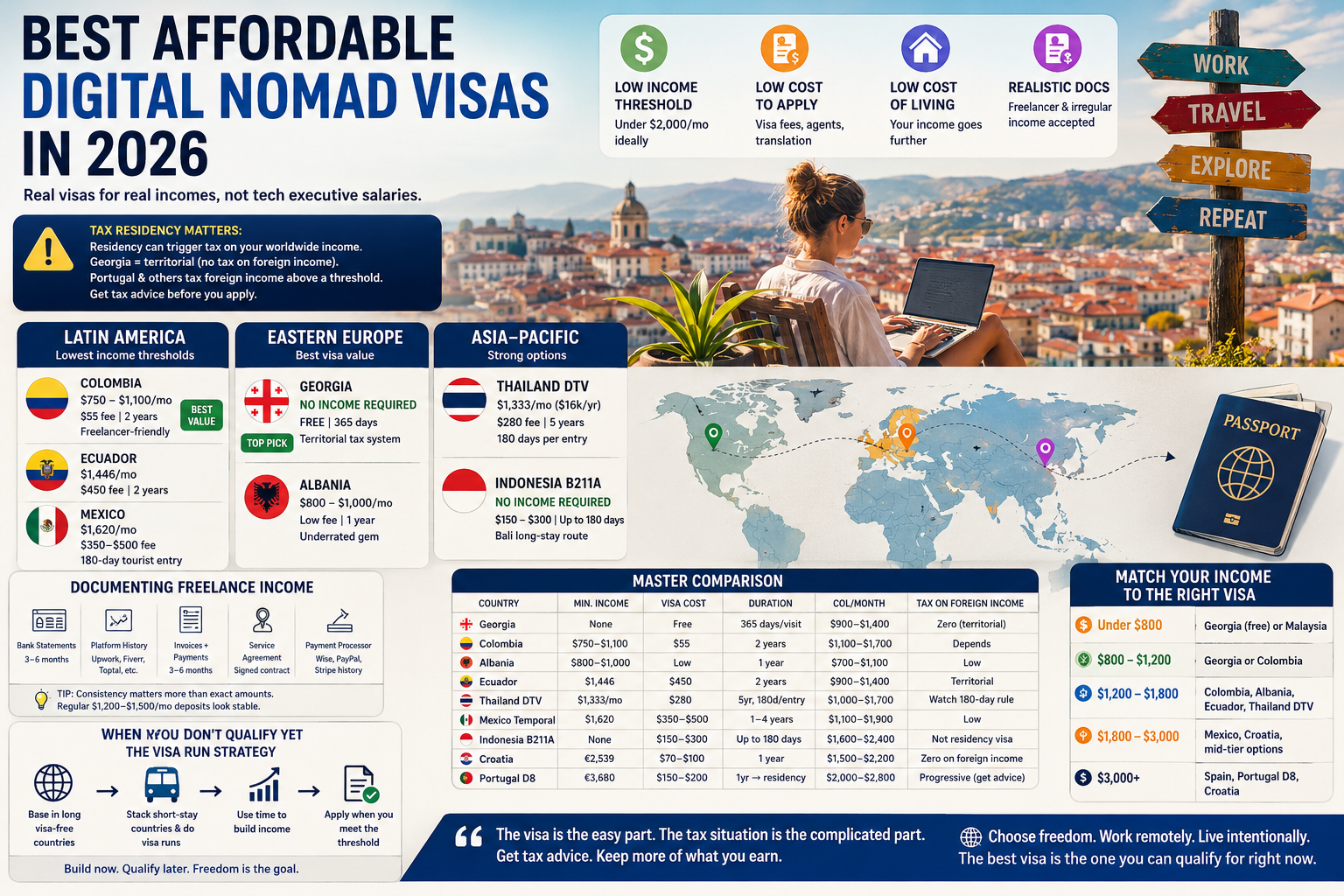
Master Comparison: Affordable Digital Nomad Visas 2026
| Country | Min. Income | Visa Cost | Duration | COL/Month | Tax on Foreign Income |
|---|---|---|---|---|---|
| Georgia | None | Free | 365 days/visit | $900–$1,400 | Zero (territorial) |
| Colombia | ~$750–$1,100 | ~$55 | 2 years | $1,100–$1,700 | Depends on residency status |
| Albania | ~$800–$1,000 | Low | 1 year | $700–$1,100 | Low on foreign income |
| Ecuador | ~$1,446 | ~$450 | 2 years | $900–$1,400 | Territorial |
| Thailand DTV | ~$1,333/mo | ~$280 | 5yr, 180d/entry | $1,000–$1,700 | Watch 180-day rule |
| Mexico Temporal | ~$1,620 | ~$350–$500 | 1–4 years | $1,100–$1,900 | Low on foreign income |
| Indonesia B211A | None | $150–$300 | Up to 180 days | $1,600–$2,400 | Not a residency visa |
| Croatia | ~€2,539 | ~$70–$100 | 1 year | $1,500–$2,200 | Zero on foreign income |
| Portugal D8 | ~€3,680 | ~$150–$200 | 1yr → residency | $2,000–$2,800 | Progressive — get advice |
Documenting Freelance Income for an Affordable Digital Nomad Visas
This is the section my Medellín neighbor actually needed. And the one most guides skip in favor of requirements that assume a corporate employment contract.
Most budget nomads’ income is: Upwork payments, direct client invoices, PayPal transfers, occasional platform payouts, inconsistent monthly totals. Here’s what actually works across most affordable digital nomad visas programs.
What immigration generally accepts:
- Bank statements (3–6 months) — showing regular deposits from foreign sources. Consistency matters more than the exact amount. Irregular $3,000 months followed by $200 months flag applications. Consistent $1,200–$1,500/month deposits look stable.
- Platform payment history — Upwork’s “Earnings” export, Fiverr payment history, Toptal statements. Most immigration offices now recognize these platforms.
- Client invoices + payment confirmations — 3–6 months of invoices plus corresponding payment receipts. Even informal invoices work if they’re consistent.
- Freelance service agreement — a signed agreement stating a monthly retainer or per-project fee. You can create a simple agreement with a regular client specifically for visa documentation — it’s legitimate and commonly done.
- Wise, PayPal, or Stripe transaction history — exported statements from payment processors count as income documentation for most low-threshold programs.
⚠️ Translation and apostille add time and cost. Most countries require documents in the local language or officially translated. Criminal background checks typically need an apostille. This adds $100–$300 and 2–4 weeks. Budget for it and start early — it’s the most common reason applications are delayed, not the income documentation itself.
When You Don’t Qualify Yet: The Visa Run Strategy for Budget Nomads
If you’re earning $600–$800/month while building your freelance business, most formal affordable digital nomad visas aren’t accessible yet. The exception is Georgia — no threshold — and the informal B211A Bali route.
For everyone else below the threshold, the pragmatic strategy is:
- Base in a long visa-free country: Georgia (365 days), Malaysia (90 days), Mexico (180 days) — all significant time without formal documentation
- Stack short-stay countries: Vietnam (90 days) → Cambodia (30 days, visa run) → Vietnam again (90 more days). This loop costs $55–$85 in visa fees and $150–$250 in transport per run.
- Use the time to build income: the goal isn’t perpetual visa runs. It’s using 6–12 months of affordable bases to build income to the point where you qualify for a proper long-stay visa.
“I spent 14 months doing the Southeast Asia loop before my income cleared the Thailand DTV threshold. Annoying? Yes. Sustainable? Completely. Vietnam to Cambodia to Vietnam to Thailand — seven border crossings, maybe $900 in total visa fees and runs across the whole period. The moment I cleared $16,000/year consistently, I applied for the DTV and stopped doing border math in my head. Worth every cross-border bus.”
— Jamie, 27, copywriter and content strategist, Chiang Mai
Matching Affordable Digital Nomad Visas to Your Income: The Decision Framework
| Monthly Income | Best Affordable Digital Nomad Visas | Strategy |
|---|---|---|
| Under $800 | Georgia (visa-free) or Malaysia tourist | Base cheaply, build income, don’t stress the visa yet |
| $800–$1,200 | Georgia (365d free) or Colombia with clean docs | Georgia needs nothing; Colombia possible if income is consistent |
| $1,200–$1,800 | Colombia, Albania, Ecuador, Thailand DTV | Strong options across three regions — pick by lifestyle preference |
| $1,800–$3,000 | Mexico Temporal, Croatia, most mid-tier options | Europe accessible at upper end; Latin America very comfortable |
| $3,000+ | Spain, Portugal D8, Croatia | EU residency and citizenship pathway opens up |
🔑 The most important thing nobody tells you about affordable digital nomad visas: the visa is the easy part. The tax situation is the complicated part. Spend more time understanding your tax obligations than your visa options. The visa gets you legal residence. The tax situation determines how much of what you earn you keep. A one-hour consultation with a nomad-specialist accountant before applying for any formal residency visa is the best $150 you’ll spend in this process.
Final Thoughts: The Best Affordable Digital Nomad Visas Is the One You Can Actually Qualify For Right Now
The guide I wanted to write when I had that conversation in Medellín isn’t about finding the best visa on paper. It’s about finding the best affordable digital nomad visas for your actual income, actual documentation, and actual life.
For most budget nomads earning $1,000–$1,800/month, the answer in 2026 is one of four: Georgia for the easiest path, Colombia for the most accessible formal visa, Thailand DTV for the best Asia-based structure, or the slow-build strategy of using visa-free countries to accumulate income until better options open up.
The Spanish and Portuguese visas are real goals. They’re just not where most of us start.
My neighbor in Medellín is still there. On her second Colombia visa renewal, working with three retainer clients, earning more than three times what she made when we met. She got the affordable digital nomad visas when it felt inaccessible. The income followed.
That’s usually how it goes.
For the cost of living context that makes these visa decisions meaningful, check our cheapest cities for remote workers 2026, Vietnam cost of living guide, and Thailand cost of living guide. If you’re still building toward the income threshold, our guide on digital nomad jobs with no experience covers how to get there.
Want honest visa guides, real budget breakdowns, and nomad strategies that work on actual incomes?
No aspirational content. No platinum card assumptions. Just what works — weekly.
Related Articles:
- Digital Nomad Budget 2026: Real Costs from 53 Nomads
- Cheap Countries for Digital Nomads 2026
- Cheapest Cities for Remote Workers 2026
- Cost of Living in Vietnam for Digital Nomads 2026
- Cost of Living in Thailand for Digital Nomads 2026
- Cost of Living in Bali for Digital Nomads 2026
- Digital Nomad Jobs No Experience: 90-Day Roadmap
- Slow Travel on a Budget
